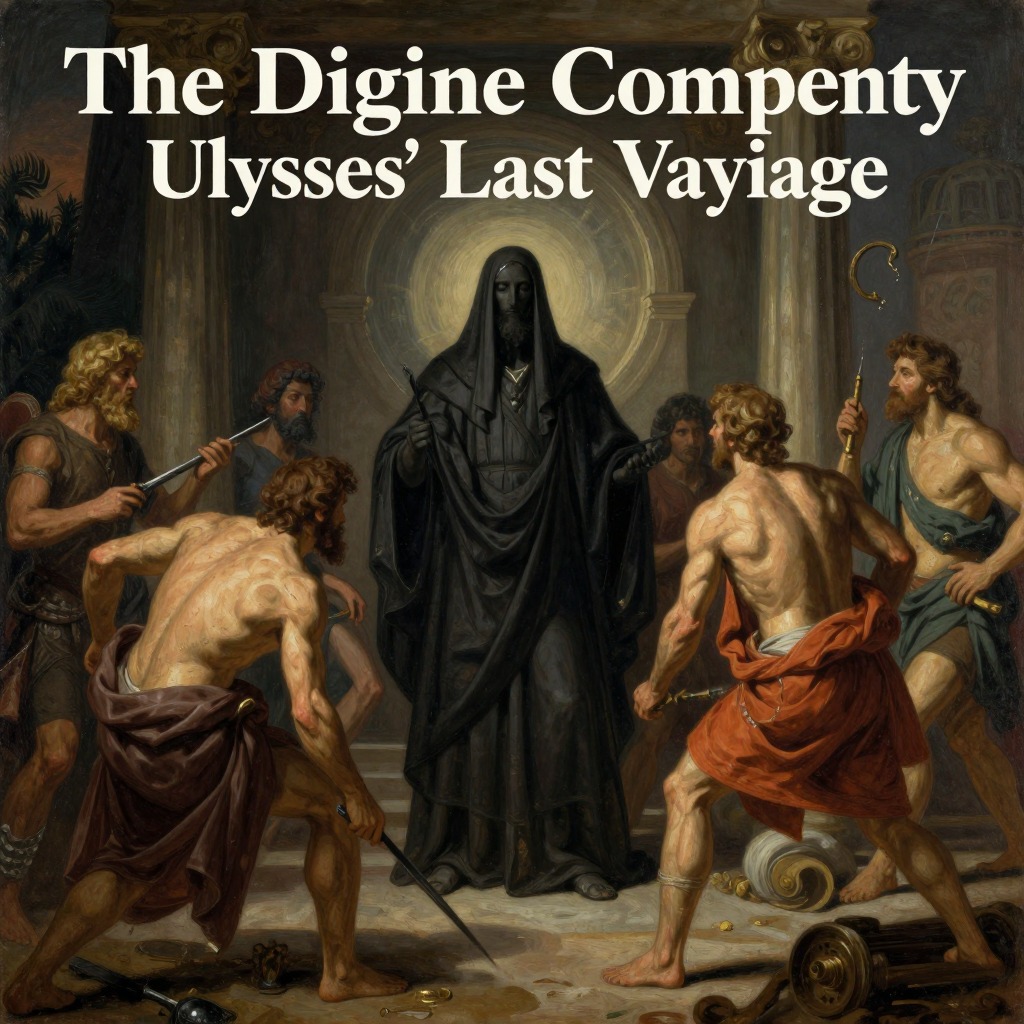
Ulysses and Diomed
Ulysses and Diomed are a pair of Greek heroes condemned together in the Eighth Bolgia of Dante's Hell, where they are punished for their fraudulent counsel during the Trojan War. Their shared flame, which speaks with a single voice, recounts Ulysses' final, forbidden voyage beyond the Pillars of Hercules, a journey that ends in shipwreck and serves as a central exemplum of the misuse of intellect and eloquence.
Identity and Punishment
In the eighth circle of Malebolge, the poets encounter a flame that moves with a divided tip, "as if it were the tongue that spake" . Virgil explains that within this single fire are tormented Ulysses and Diomed, who "unto vengeance run as unto wrath" . Their shared punishment reflects their shared guilt: together they devised the stratagem of the Trojan Horse, which opened the city to destruction; they also conspired to steal the Palladium from Troy's temple, and Ulysses tricked Achilles into revealing his identity, leading to the hero's death at Troy. The flame that encloses them is both their prison and their voice, a fitting contrapasso for counselors who used speech to deceive.
The Voyage of Ulysses
When Virgil, speaking in Greek, asks the flame to tell "whither, being lost, he went away to die" , the greater horn of the flame begins to murmur and wave, and then speaks. Ulysses recounts that after leaving Circe, who had detained him near Gaeta for more than a year, neither his love for his son, nor reverence for his aged father, nor the affection due to Penelope could overcome his desire "to be experienced of the world, and of the vice and virtue of mankind" . He set out on the open sea with a single ship and a small, loyal crew, all of them old and slow. They sailed past Spain and Morocco, and then to the narrow passage where Hercules had set his landmarks as a warning that man should go no farther. Ulysses urged his companions on with a famous exhortation: "Consider ye the seed from which ye sprang; ye were not made to live like unto brutes, but for pursuit of virtue and of knowledge" .
The Shipwreck and Death
After five months of sailing south, the crew sighted a mountain, dim in the distance and higher than any they had ever seen. Their joy turned to weeping, for a whirlwind rose from the new land, struck the ship's prow, and spun it three times; on the fourth turn, the stern rose and the prow plunged downward "as pleased Another, until the sea above us closed again" . The mountain they saw was Mount Purgatory, and their shipwreck was divine punishment for their transgressive voyage. Ulysses' narrative ends with the sea closing over them, a final image of the limits of human reason when it seeks to exceed its ordained bounds.
Thematic Significance
Ulysses and Diomed represent the sin of fraudulent counsel—the use of eloquence and intelligence to deceive others for personal or political gain. Their punishment in a divided flame mirrors the division they sowed among men. Ulysses' own story, however, transcends mere condemnation: it is a powerful meditation on the restless human desire for knowledge and experience, a desire that Dante himself shares but must learn to direct toward divine truth rather than worldly adventure. The episode serves as a warning against the pride of intellect that seeks to go beyond the limits set by God, a theme that resonates throughout the entire Comedy. The fact that Ulysses speaks alone, while Diomed remains silent within the same flame, emphasizes that it is Ulysses' particular sin of intellectual arrogance that Dante most wishes to examine and condemn.